Experts say taking a few steps to prepare your car can save you trouble when driving conditions deteriorate.
By Dennis McCafferty
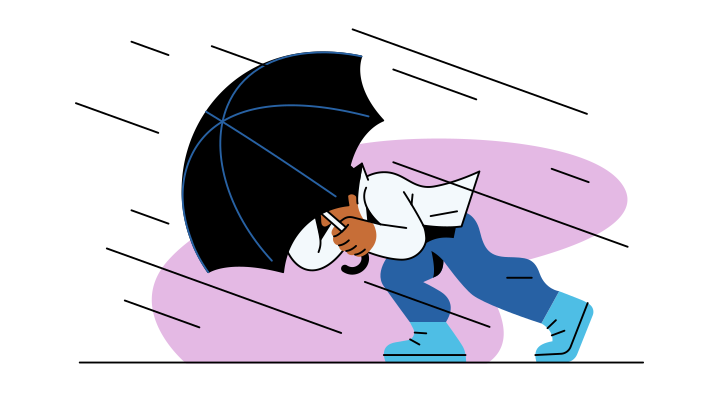
Unless you do all of your driving on, say, a Caribbean island, the truth is that most of us will have to deal with cold weather — and possibly snow and ice — on the road.
The consequences of such driving can be difficult on motorists and their vehicles. Batteries and other parts wear down faster, and street conditions can lead to hazards. In fact, the total rate of crashes increases significantly during the winter months, according to the National Highway Traffic Safety Administration. In 2007 (the last year for which data is available), nearly 1.6 million crashes occurred in December, January and February. And while that accounts for more than one-quarter of the year’s overall crashes, keep in mind motorists drive less during winter months.
Fortunately, there are many precautions and best practices that can greatly reduce the hassle factor for drivers this winter, experts say. So consider these tips as temperatures dip:
Prevent trouble before it starts. Get your battery checked out, as well as your antifreeze levels. “These should be checked early in the fall,” says Rick Jorgensen, a former instructor at the automobile technology department at Northwest Kansas Technical College and now a Goodland, Kansas-based general manager for NAPA Auto Parts. “You should check not only for the level of the fluid, but what accounts for the fluid. I’ve seen cases where it got down to 30 degrees for just two hours and an engine will be ruined because there’s only water in there. The best mixture is 50/50 water to antifreeze.”
He also suggests changing the oil at this time and using 5W-30, which is better for cold weather because the oil can get to critical components more quickly in winter than 10W-30. “And your tires need to be checked to make sure they have plenty of tread life in snow or ice,” Jorgensen says. “Thin tread will cause an accident even if you drive carefully.”
Clear your vehicle of all ice and snow. Too often, motorists simply scrape off enough ice and snow on the windshield to see. But the wet, slick stuff that gathers on lights, hoods and trunk surfaces also present obstructions to you and other drivers, Jorgensen says. And snow must be removed from headlights and brake lights — and the headlights should be turned on — to ensure that other drivers can see you.
This kind of accident prevention will help you see upcoming hazards more clearly, of course, but there’s no guarantee you’ll avoid all icy patches. So if you do hit a slick spot, don’t panic. “If you start to spin out of control, let off the brake and steer in the direction of your slide,” he says.
Start your ride the right way. A vehicle needs a few minutes of warm-up time before operating at optimal capacity. While some experts endorse a minute or two of ‘idle’ time, there’s an alternative option. “Drive slowly for the first few miles until engine and transmission reach normal operating temperature,” says Dennis Madden, CEO of the Automatic Transmission Rebuilders Association, an Oxnard, Calif.-based trade association that represents more than 2,300 mechanics and auto-shop owners. “Lower outside temperature reduces thickening engine fluids’ ability to lubricate. You should also avoid idling for extended periods. Aside from wasting fuel, many transmissions don’t create lube flow with the gear shift in “park,” so internal components could get damaged if they are spinning cold with no lube flow.”
Get unstuck without damage. Let’s face it: We’ve all gotten caught in a slick brew of ice and snow somewhere. It’s a short-term problem that could cause long-term headaches if you don’t get out of the mess the right way. Madden cautions drivers on spinning the wheels, which can cause severe (and costly) transmission damage. “Many cars today use a computer to control transmission operation,” he says “Spinning the wheels registers as speed increasing, but the computer doesn’t know the car isn’t actually moving. If the wheels do gain traction, the speed will drop suddenly with the engine locked to the drive wheels. This can be catastrophic to the transmission.” The best way to get out, he says, is the old-fashioned rocking-back-and-forth method. Or wave down a passerby to push the car out.
Go to these resources from Uncle Sam. The Federal Citizen Information Center posts what it calls ‘Glove Box Tips’ online. (They’re short and can print out small enough to fit in the glove compartment.) Among the tips in the “Getting Your Vehicle Ready for Winter” link: Put a bottle of fuel de-icer in the tank once a month to help keep moisture from freezing in the fuel line; replace old windshield wiper blades and consider purchasing special, rubber-clad ones to fight ice buildup; clean road grime from all headline/brakelight surfaces with a dry rag to avoid scratching. (For more, visit the National Institute for Automotive Service Excellence website.)
Taking these steps should help reduce winter driving problems and make the drive more enjoyable.
Bio: Dennis McCafferty is a freelance writer with extensive experience in the automotive field, as well as with NASCAR. He has written for Chrysler magazine, UAW-GM People magazine, Dodge Tomorrow magazine, and Corvette Quarterly.
The views and opinions expressed in this article are solely those of the author and not necessarily those of Progressive Casualty Insurance Company or its affiliates.