By David Lukas
In response to a wave of artificiality and commercialism in the American art scene during the late 1960s, a handful of revolutionary artists shifted their artistic vision out of the indoor gallery and superimposed it upon landscapes. The result was a movement of large-scale "Earth Art" installations that peaked during the 1970s.

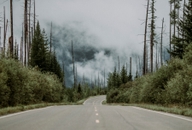
Road leading through Bonneville Salt Flats.
© Lonas Kaltenbach. Lonely Planet Images.
Many of the huge art pieces were created in the deserts of Nevada, New Mexico, Utah and Arizona as ephemeral installations that now exist only in photos and videos. While the art world has evolved in new directions and the Earth Art movement has been largely forgotten, a few of these haunting installations have endured like the very earth they were built upon. For people who are willing to seek them out, the art seems to have grown in power with the passage of time.
Spiral Jetty
Located on the salt flats of the Great Salt Lake in Utah, the "Spiral Jetty" by Robert Smithson is the most famous and perhaps the most photographed of all Earth Art installations. The jetty is a 1,500-foot counterclockwise spiral of black basalt boulders rising out of the red-hued waters of the Great Salt Lake. Visiting the site is free; check the Web site for directions on how to get to this fascinating place.
Lightning Field
"Lightning Field," an eerie Earth Art installation in the remote deserts of New Mexico, is considered one of the most significant artworks of the late 20th century, although only 1,000 visitors have viewed it since its completion in 1977. Consisting of 400 vertical polished stainless-steel rods installed over a 1-mile by 1-kilometer grid, this piece cannot be viewed from one location or easily photographed. It must be experienced by walking through and around it, preferably at sunrise or sunset. Overnight visits to this installation are by reservation only from May to October and cost $250 a person. Groups are kept small to ensure a high-quality experience for each visitor.
Double Negative
Created by Earth Art pioneer Michael Heizer, the famous "Double Negative" sculpture is notable for what it isn't – in fact it is nothing more than two gigantic trenches cut across the Nevada Desert. Still, the piece continues to provoke debate about the lines between what is rock and what is sculpture, and what kind of art exists when something is removed rather than added. It’s accessible to everyone on a reasonable dirt road from Overton, Nev; see the Web site for directions.
Effigy Tumuli
Also created by Heizer, the "Effigy Tumuli" in Buffalo Rock State Park, Ill., pays homage to Native American burial grounds. Mounds of Illinois clay were formed into huge sculptures of five animals – a snake, turtle, catfish, frog and water strider – that must be walked or seen from a distant vantage point to appreciate. The snake alone is 2,070 feet long!
Roden Crater Volcano
Begun in the late 1970s and still not finished, the Roden Crater Volcano project in northern Arizona has become the hottest ticket that hasn't been seen yet. Only a handful of people have been granted permission to view the ongoing construction and have come back with rave reviews of the scale of this project, an attempt to transform a 400,000-year-old, two-mile-wide volcano into a mind-bending Earth Art masterpiece that plays with moonlight, starlight and space.
Bio: David Lukas is a professional naturalist who lives just outside Yosemite National Park. He leads nature tours and writes about the plants and animals of places ranging from Borneo and Tanzania to Nova Scotia.
The content provided by Lonely Planet Publications, while as accurate as possible, is provided "as is." Neither we, nor Lonely Planet Publications, accept any responsibility for any loss, injury or inconvenience resulting from this information. You should verify critical information (like visas, health and safety) before you travel.